


Same Viscosity. Completely Different Texture. Why?
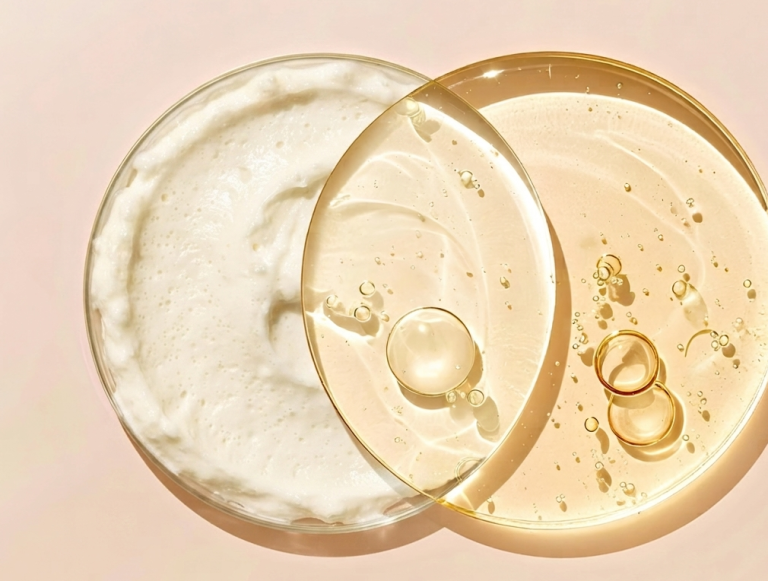
Why can two cosmetic gels with exactly the same viscosity feel completely different on the skin?
This is one of the most common paradoxes in cosmetic formulation.
Two gels may display exactly the same viscosity when measured with a viscometer, yet deliver completely different sensory experiences. One may feel fresh, light and silky, while the other appears thick, sticky or difficult to spread.
How is this possible?
The answer lies in one word: rheology.
Viscosity tells only part of the story
Viscosity is usually the first parameter formulators evaluate when developing a cosmetic gel.
It measures a product’s resistance to flow. However, two formulations with identical viscosity can behave very differently during application.
Why?
Because the sensory experience depends not only on viscosity itself, but also on how that viscosity changes when mechanical stress is applied—during dispensing, spreading on the skin or massaging.
This is exactly what cosmetic rheology studies.
Rheology: the true sensory signature of a gel
Rheology describes how a material responds to mechanical forces.
In cosmetic gels, it directly influences:
- ease of dispensing,
- spreadability,
- fresh or cocooning skin feel,
- perceived lightness,
- tackiness,
- formulation stability,
- suspension of pigments, active ingredients and exfoliating particles.
As a result, two gels with exactly the same viscosity can deliver completely different sensory experiences simply because their rheological profiles are different.
For consumers, the viscosity value shown on a technical data sheet is ultimately of little importance. What truly matters is the perceived texture: freshness upon application, glide, absorption rate and the final skin feel.
At PolymerExpert, rheology is at the heart of innovation
At PolymerExpert, rheology is more than a characterization tool—it’s a formulation science that has guided the development of our polymers for over twenty years.
Our expertise in polymer synthesis enables us to design ingredients with specific and reproducible rheological behaviors, helping formulators meet the ever-growing expectations of both brands and consumers.
This expertise is applied throughout every stage of development:
- designing new polymers,
- developing natural gelling agents,
- creating alternatives to carbomers,
- optimizing formulation stability,
- enhancing sensory performance.
Every day, our teams also support formulators in solving texture-related challenges. Whether a formulation lacks glide, feels stringy, is too tacky or fails to suspend active ingredients effectively, the underlying issue is often rheological—and can be understood and optimized.
ViscoPure®: when rheology becomes a tool for sensory design
This expertise is fully embodied in ViscoPure®, our 100% bio-based aqueous gelling agent, developed to meet the evolving expectations of modern cosmetics.
Built on our know-how in polymer science and rheology, ViscoPure® enables formulators to create elegant, stable and high-performing textures while reducing reliance on traditional synthetic polymers.
Beyond its excellent thickening efficiency, ViscoPure® acts as a true rheology modifier, allowing precise control over formulation structure to optimize performance, stability and sensory profile.
Depending on the formulation, ViscoPure® can help achieve:
- fresh and lightweight gels,
- elegant, non-tacky textures,
- excellent spreadability,
- efficient suspension of pigments and particles,
- enhanced stability,
- a premium sensory experience.
More than simply a natural gelling agent, ViscoPure® is a genuine texture design tool, enabling formulators to transform technical performance into a distinctive sensory experience.
Beyond viscosity: designing the user experience
When consumers apply a serum, gel cream or facial treatment, they do not evaluate viscosity.
They evaluate how it feels.
Understanding rheology allows formulators to transform a technically sound formulation into one that delivers a truly memorable sensory experience.
That is why rheology has become one of the most powerful tools for developing innovative, high-performance and differentiated cosmetic textures.
Because two gels can have exactly the same viscosity.
Yet on the skin, they can tell completely different stories.