


Ring-Opening Polymerization: Designing the Next Generation of Biodegradable Polymers for Medical Applications.
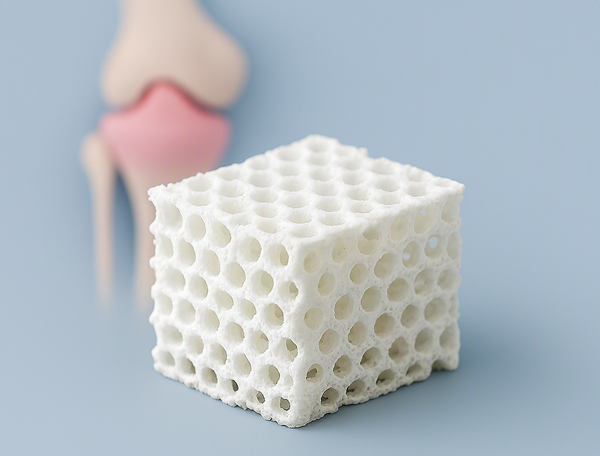
What if a medical implant could perform its function, support healing, and then gradually disappear once it is no longer needed?
This question is at the heart of many current developments in biomedical materials. As healthcare moves toward less invasive, more patient-centered and more cost-efficient solutions, biodegradable polymers are playing an increasingly important role in the design of next-generation medical devices.
In many clinical situations, resorbable materials can eliminate the need for a second surgical procedure to remove a temporary implant or device. This can reduce patient burden, limit post-operative complications, simplify care pathways and contribute to lower overall healthcare costs.
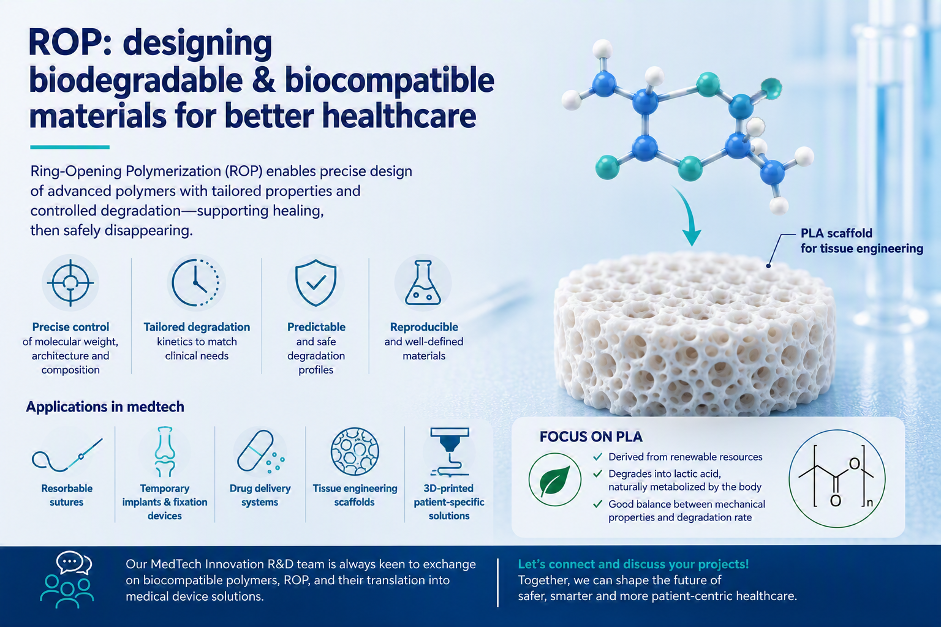
Among the key technologies enabling this progress, ring-opening polymerization, or ROP, has become a major tool for designing biodegradable and biocompatible polymers with controlled structures, predictable degradation profiles and tunable performance.
At PolymerExpert, ROP is part of a broader expertise in advanced polymer design and custom synthesis. Our teams support the development of tailor-made biodegradable polymers, from early-stage feasibility studies to scale-up, with a strong focus on structure-property relationships, reproducibility and application-driven material performance.
Why ring-opening polymerization matters
Ring-opening polymerization is a powerful synthetic route used to produce aliphatic polyesters from cyclic monomers such as lactide, glycolide or caprolactone.
Its main advantage lies in the high level of control it can provide over polymer structure and properties. By carefully selecting the monomer, catalyst, initiator and reaction conditions, it is possible to fine-tune key parameters such as:
- Molecular weight
- Polymer architecture
- Copolymer composition
- Crystallinity
- Mechanical behavior
- Thermal properties
- Hydrophobicity
- Degradation kinetics
This level of control is particularly important in medical applications, where the material must meet demanding requirements: mechanical stability during use, biocompatibility, processability, reproducibility and progressive degradation in a biological environment.
In other words, ROP does not only produce biodegradable polymers. It allows polymer chemists to design materials whose properties can be adapted to specific therapeutic and clinical needs.
From polymer synthesis to application-driven material design
Developing a biodegradable polymer for medical applications is not only a question of chemistry. It requires a precise understanding of how molecular structure impacts the final behavior of the material.
Small changes in polymer composition, molecular weight, architecture or stereochemistry can significantly influence mechanical properties, degradation rate, morphology, processability and final device performance.
This is where PolymerExpert brings specific value: combining polymer chemistry, material science and custom development capabilities to design materials according to a targeted application profile.
Depending on the project requirements, our teams can support:
- Custom synthesis of biodegradable polymers and copolymers
- Molecular weight and architecture optimization
- Degradation profile tuning
- ROP-based polymer development
- Feasibility studies and iterative formulation work
- Small-batch production for R&D evaluation
- Scale-up toward larger quantities
This integrated approach enables medical device developers to move from a material concept to a more defined and application-ready polymer solution.
PLA: a cornerstone of biodegradable biomaterials
Polylactic acid, commonly known as PLA, is one of the most established examples of biodegradable polymers obtained through ring-opening polymerization.
PLA is widely used and studied in the biomedical field because it combines several valuable characteristics:
- It can be derived from renewable resources
- It offers good processability through extrusion, injection molding or additive manufacturing
- It provides a useful balance between mechanical performance and biodegradability
- It degrades into lactic acid, a molecule that can be metabolized by the body
These properties make PLA an attractive material for applications where temporary mechanical support is required before gradual resorption.
However, the real strength of PLA-based materials lies in their adaptability. Depending on molecular weight, stereochemistry, crystallinity and processing conditions, PLA properties can be adjusted to meet different application profiles.
Beyond PLA: expanding the biomaterial toolbox
While PLA is a cornerstone of biodegradable materials, other ROP-derived polymers further expand the range of possibilities available to medical device developers.
PLGA, poly(lactic-co-glycolic acid), is especially valuable for controlled drug-delivery applications. By adjusting the ratio between lactic acid and glycolic acid units, it is possible to modulate degradation rates and drug release profiles.
PCL, polycaprolactone, offers a slower degradation profile and greater flexibility, making it suitable for applications requiring longer-term mechanical support or more elastic material behavior.
Together, PLA, PLGA, PCL and related copolymers provide a versatile platform for designing materials with different degradation timelines, mechanical profiles and processing characteristics.
PolymerExpert’s expertise lies in this ability to adapt polymer chemistry to the functional needs of the final application. Rather than offering standard materials only, our approach is to work on customized polymer structures designed to address specific technical, processing or performance challenges.
Enabling next-generation medical devices
Biodegradable polymers produced by ROP are already used, or actively explored, across a wide range of medical applications, including:
- Resorbable sutures
- Temporary implants
- Orthopedic fixation devices
- Controlled drug-delivery systems
- Tissue-engineering scaffolds
- Patient-specific medical devices produced through additive manufacturing
Each application requires a precise balance between performance and degradation.
For example, a fixation device must retain sufficient mechanical strength during the early healing phase before progressively losing integrity. A drug-delivery system must degrade in a controlled manner to release an active ingredient over a defined period. A tissue-engineering scaffold must provide a temporary structure that supports cell adhesion, proliferation and tissue regeneration before being gradually replaced by newly formed biological tissue.
This is where advanced polymer chemistry becomes a strategic design tool.
Supporting innovation through custom polymer development
For companies developing next-generation medical devices, access to custom polymer synthesis capabilities can be decisive.
A standard commercial polymer may not always provide the right combination of degradation time, mechanical behavior, processability and biological performance. In these cases, tailor-made polymer development can help bridge the gap between an initial concept and a functional material solution.
PolymerExpert supports this innovation process by combining scientific expertise, laboratory-scale development and scale-up capabilities. This allows project teams to explore different polymer compositions, compare material behaviors, refine specifications and progressively move toward the most relevant solution for their application.
Our role is not only to synthesize polymers, but to help design materials that fit the intended use.
A key technology for regenerative and personalized medicine
As regenerative medicine, minimally invasive surgery and personalized healthcare continue to evolve, biodegradable polymers will play an increasingly important role in the development of safer, smarter and more effective medical devices.
Ring-opening polymerization offers a robust and highly adaptable platform to design such materials. By enabling precise control over polymer composition, architecture and degradation, ROP helps bridge the gap between molecular design and clinical application.
For medical device developers, this opens the door to a new generation of materials engineered not only to perform, but also to disappear when their mission is complete.
At PolymerExpert, we support the development of advanced polymer-based solutions for demanding medical and healthcare applications, from early-stage material design to custom synthesis and scale-up.
If you are exploring innovative biodegradable materials for your next medical device project, our team would be pleased to discuss how tailored polymer chemistry can support your development.