


Film Formers: The Key to Long-Lasting and Sensorially Appealing Formulations
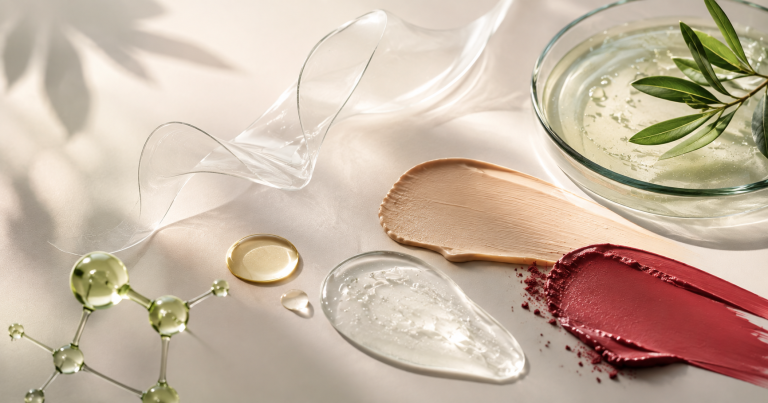
Long-lasting products have become a key part of the cosmetics market: transfer-resistant foundations, long-wear lipsticks, water-resistant sunscreens, waterproof mascaras, styling gels, and hybrid skincare-makeup formulations.
For formulators, however, long-lasting performance does not refer to a single property. Depending on the application, the objective may be to extend wear over time, reduce transfer, or improve abrasion resistance.
These properties are related, but they do not necessarily rely on the same mechanisms. A film, for example, may offer excellent transfer resistance without providing the same level of abrasion resistance.
Formulating for long wear is therefore about finding the right balance between film performance and sensory experience.
Understanding the Role of Film Formers
Film-forming agents, or film formers, play a central role in building long-lasting performance. After application, they contribute to forming a continuous film on the skin, lips, hair, or nails.
During drying or stabilization, volatile components gradually evaporate while polymers concentrate to form the film. Its final structure depends on several factors, including cohesion, adhesion, flexibility, and film thickness.
These properties partly determine how the product behaves over time:
- insufficient cohesion can lead to film degradation
- insufficient adhesion can result in migration or transfer
- insufficient flexibility can compromise comfort
- an overly thick film can increase the perception of product on the skin
The choice of film former therefore cannot be considered independently from the rest of the formulation. Oils, emollients, waxes, pigments, and other ingredients also contribute to the properties of the final film.
Three Key Dimensions of Long-Lasting Performance
For formulators, several dimensions can be considered when working on the wear of a formulation.
- Wear over time
The objective is to maintain the film and its performance for as long as possible after application, while limiting degradation or migration.
- Transfer resistance
This refers to the ability of the product to remain on the original surface and limit transfer onto skin, clothing, or other surfaces during contact.
- Abrasion resistance
This concerns the ability of the film to maintain its integrity despite repeated rubbing or friction.
These three criteria are not interchangeable. A film former that performs particularly well in one area will not necessarily be the best choice for the others.
Formulation therefore starts by identifying the performance that matters most for the application, and then building a film architecture suited to that specific requirement.
How Can Wear Be Improved Without Compromising the Finish?
Increasing the amount of film former may seem like an obvious way to improve wear. However, final performance does not depend on concentration alone.
The choice of polymer, its structure, its behavior after application, and its compatibility with the oil phase can all significantly influence the properties of the resulting film.
A more resistant film can also become more perceptible, more rigid, or less comfortable. Conversely, focusing solely on flexibility may compromise wear performance.
The objective is therefore not to create the strongest possible film, but to select the film former and formulation architecture that are best suited to the desired result.
This is where bio-based film formers can offer formulators new possibilities: not necessarily by replicating the performance of conventional solutions, but by providing different combinations of wear, natural origin, and sensory performance.
OleoFilm® Green: Enhancing Wear Without Weighing Down the Finish
OleoFilm® Green is a 100% bio-based film former, soluble in the oil phase, developed to contribute to the performance of long-lasting formulations.
It is particularly interesting when transfer resistance is a key objective.
OleoFilm® Green has been evaluated at 3% in foundation formulations and demonstrated a four-fold reduction in transfer in transfer-resistance testing. This result highlights its potential to improve makeup wear while limiting product transfer.
Its role should, however, always be considered in relation to the application and the other performance criteria being targeted. Transfer resistance, wear over time, and abrasion resistance do not necessarily rely on the same mechanisms.
The value of OleoFilm® Green therefore lies in the combination of targeted transfer-resistance performance, bio-based origin, and sensory quality of the final finish.
How Can Adhesion, Shine, and Comfort Be Combined?
In some applications, particularly lip products, long-lasting performance also depends on the ability of the product to adhere to the surface while maintaining a pleasant sensory experience.
This is particularly important for glosses, lip oils, balms, and sticks: the product needs to adhere sufficiently to extend wear, without creating an excessively sticky or uncomfortable feel.
OleoShine® Green CA is a 100% bio-based film former that enables formulators to work simultaneously on adhesion, shine, and sensory comfort.
Its value does not lie in providing complete transfer resistance on its own. Rather, it contributes to improved wear by enhancing the adhesion of the film, while providing a sensory profile suited to applications where shine and comfort are essential.
In lip products, this combination makes it possible to work on grip, wear, shine, and comfort within the same formulation architecture.
Sensory Performance: A Key Dimension of Long-Lasting Formulations
A long-lasting formulation should not be judged solely by its ability to stay in place.
For consumers, performance must remain compatible with a pleasant user experience: a transfer-resistant foundation should maintain a natural finish, a long-wear lipstick should remain comfortable, and a styling product should deliver lasting hold without creating an excessively rigid feel.
Sensory performance has therefore become a genuine formulation parameter, alongside resistance and adhesion.
For formulators, the challenge is to find the right balance between film properties and the desired sensory profile.
This is also where bio-based solutions can open up new formulation opportunities, enabling the exploration of different film architectures and new compromises between performance and user experience.
Towards Smarter Long-Lasting Performance
Long-lasting performance is therefore not a single property.
Depending on the application, formulators may seek to optimize wear over time, transfer resistance, adhesion, or abrasion resistance, while preserving the sensory profile of the product.
The choice of a film former must therefore be part of a broader approach to formulation architecture.
With OleoFilm® Green and OleoShine® Green CA, PolymerExpert offers two complementary approaches to long-lasting performance: one particularly suited to transfer-resistance challenges, and the other designed to work on adhesion, shine, and comfort, especially in lip products.
The objective is not to pursue maximum resistance at all costs, but to build the right balance between performance, bio-based origin, and sensory appeal.
Because a successful long-lasting formulation is not simply one that stays in place — it is one that remains pleasant to wear.